RocketReach vs Seamless in Head-to-Head Comparison
Seamless Team
April 24, 2026
This article compares RocketReach vs. Seamless for sales prospecting, including how the two platforms differ across contact discovery, data enrichment, list building, automation, integrations, pricing, and workflow support.
If RocketReach and Seamless are on your mind, then you're in the right place.
It means you're looking to sustainably expand your pipeline with an effective sales intelligence + automation platform that can increase customers, improve your prospecting plan, and close with more deals.
When sales support and growing business leads matters, then quite often smart pros favor one of two choices: Seamless or RocketReach.
Both offer similar capabilities, including verified customer databases and prospecting tools.
Despite their similarities, however, they boast different roster sizes, automation features, and other key functionalities.
Between you and me, Seamless and RocketReach are both good choices, but the real difference-maker is which one is best to help you grow your base, scale your business, and net more sales?
TL;DR
Seamless is the better choice for teams that want a broader, more scalable prospecting platform, while RocketReach is a strong fit for contact discovery, company research, and list building.
RocketReach keeps the workflow relatively focused, but Seamless adds enrichment, buyer intent, automation, and sales engagement in one connected platform.
For teams focused on building pipeline at scale, Seamless offers the more complete prospecting experience.
Overview of Seamless vs. RocketReach
Seamless is an all-around sales intelligence platform that assists with every task from initial contact to closing. Seamless supports cold outreach, marketing, customer success, and more with an enriched, validated database, prospecting tools, and key automation features.
With its robust array of capabilities, Seamless simplifies work for every member of your B2B sales teams, including:
Sales leaders
Sales Development Representatives (SDRs)
RevOps agents
Prospecting pros
RocketReach is likewise a sales intelligence platform, but it focuses more on lead-building and customer databases, rather than being an all-around sales engine. It also offers automation features, but they’re centered on outreach than full pipeline support. It can also be a useful tool for sales reps, marketers, and recruiters looking to expand their contact lists.
Core Data Capabilities Compared
Both Seamless and RocketReach help sales teams find prospects and improve outreach, but they differ in the depth of data, enrichment, and broader workflow support they provide.
RocketReach
RocketReach focuses heavily on contact discovery and company data. Its platform gives users access to a large contact database and supports email, phone, company, and organizational research for outbound teams.
For teams that already know who they want to reach, RocketReach can be a straightforward way to find contact information and build prospect lists.
Pros:
Large B2B contact database
Strong contact and company lookup capabilities
Useful for targeted prospect research
Straightforward fit for sales, recruiting, and marketing teams
Cons:
Smaller reported contact footprint than Seamless
Less data depth across company and contact records
Broader enrichment and workflow capabilities are more limited
RocketReach can fall short when teams need more than contact discovery. If reps need deeper enrichment, buyer signals, automated list building, and more connected execution, they may need additional tools.
That narrower scope is also why RocketReach can still be a strong fit for its target customer. A recruiter, individual seller, or smaller outbound team that mainly needs dependable contact lookup and list building may prefer a more focused platform instead of paying for broader functionality it will not use.
Seamless
Seamless approaches contact data as part of a broader sales intelligence and prospecting workflow.
The platform has validated more than 1.3 billion contacts and combines contact discovery with company intelligence, enrichment, buyer signals, automation, and sales engagement tools.
Pros:
Larger reported validated contact footprint
Combines contact and company discovery
Supports deeper prospect and account intelligence
Better suited for continuous outbound prospecting
More capabilities can be consolidated into one platform
Cons:
Broader functionality can require additional onboarding
May be more platform than a team needs for basic contact lookup
For teams that need prospect data to feed directly into a larger outbound motion, Seamless provides more functionality around what happens before and after the contact is found.
Contact Accuracy and Verification Standards
Contact accuracy matters because even a large database has limited value if emails bounce, phone numbers no longer work, or prospects have changed companies.
RocketReach
RocketReach verifies contact data and refreshes records as new information becomes available. Popular profiles can receive more frequent monitoring, while other records may be refreshed on a regular schedule.
The platform can be useful for teams that need contact information for a defined group of prospects and do not necessarily require continuous enrichment across their entire CRM.
Pros:
Supports verified contact information
Maintains and refreshes prospect records
Useful for targeted email and phone discovery
Good fit for known-contact lookup workflows
Cons:
Refresh frequency can vary by profile
Some records may not be updated as frequently as high-interest profiles
Less focused on continuous CRM-wide enrichment
Seamless
Seamless uses real-time search and verification as part of the prospecting process. CRM Enrich can continually compare CRM information with current Seamless data to help identify stale or incomplete records.
Rather than treating verification as a one-time event, the platform is designed to continue searching for changes in contact and company information.
Pros:
Real-time contact verification
Ongoing enrichment rather than one-time lookup
Helps reduce stale CRM records
Supports contact, company, and employment updates
Verification is integrated into the broader prospecting workflow
Cons:
Advanced enrichment workflows may require CRM setup
Teams need to configure mapping and update rules to maximize value
For teams with large prospect databases, ongoing verification can be as important as finding the contact in the first place.
Data Enrichment and Integrations
Both platforms can enrich prospect records and connect with other sales tools, but the breadth of those workflows differs.
RocketReach
RocketReach adds personal and company information to prospect records and integrates with popular CRM and sales platforms.
Its integrations make it possible to move researched contacts into downstream systems without rebuilding records manually.
Pros:
Supports contact and company enrichment
Connects with popular CRMs such as Salesforce and HubSpot
Useful for feeding prospect data into an existing stack
Straightforward fit for established sales workflows
Cons:
Enrichment depth is narrower than Seamless
Teams may need additional vendors for deeper account intelligence
Broader automation can require more third-party tools
RocketReach remains useful for teams that already have a strong CRM and engagement stack and simply need contact intelligence to feed into those systems.
Seamless
Seamless supports enrichment across more than 100 contact and company data points and connects prospecting data with a larger portion of the GTM stack.
Seamless integrations include major CRMs such as Salesforce, HubSpot, Microsoft Dynamics, Pipedrive, and Zoho CRM, as well as sales engagement platforms including Salesloft, Outreach, and Mixmax.
Teams can also use Zapier to connect Seamless with thousands of additional applications, while tools such as n8n, ChatGPT, and Claude can support more customized automation and AI-driven workflows.
Pros:
Deeper contact and company enrichment
Connects with major CRM and sales engagement systems
Supports CRM imports and record enrichment
Zapier expands connectivity across thousands of applications
Fits into both traditional and AI-driven GTM stacks
Cons:
Complex integrations can require additional configuration
CRM mapping and automation setup may take time
Certain capabilities can depend on plan level
For larger teams, this can reduce the amount of manual work required to move prospect data from research into CRM and outreach systems.
Prospecting and Workflow Efficiency
The biggest difference between the platforms becomes clearer when contact data needs to turn into pipeline.
RocketReach
RocketReach supports prospect discovery, list building, and outreach assistance. Teams can search for contacts, organize prospects, and move data into their existing engagement workflows.
Pros:
Good for targeted prospect research
Supports lead list creation
Useful for individual reps and recruiters
Can fit cleanly into an existing sales stack
Cons:
More focused on discovery than end-to-end execution
Teams may need separate systems for enrichment and engagement
Less suited for complex, high-volume outbound workflows
For a user who primarily needs to find people and retrieve their contact information, that simplicity can be a benefit. The limitation becomes more noticeable when the team needs to automate larger portions of the prospecting process.
Seamless
Seamless Prospector is designed to connect lead discovery with qualification, enrichment, buyer intelligence, and outreach.
Reps can move from identifying target accounts to finding decision-makers and preparing outreach without relying on as many separate platforms.
Pros:
Supports a larger portion of the outbound workflow
Combines prospect discovery with enrichment and buyer signals
Better suited for repeatable daily prospecting
Reduces manual handoffs between systems
Designed to support pipeline generation at scale
Cons:
More functionality requires more onboarding
Teams with very simple lookup needs may not require the full workflow
List Building and Filtering
Both RocketReach and Seamless support prospect filtering and list building, but Seamless provides a broader range of account intelligence for segmentation.
RocketReach
RocketReach lets users build prospect lists using criteria such as company, industry, employee count, revenue, and other firmographic attributes.
Users can work from existing contacts or search the RocketReach database to identify relevant prospects.
Pros:
Straightforward list-building workflow
Supports common firmographic filters
Useful for targeted contact searches
Good fit for smaller or defined prospecting motions
Cons:
Fewer enrichment dimensions for advanced segmentation
Less suited for complex account targeting
High-volume list building may require more manual management
Seamless
Seamless also supports filtering by common attributes such as company, domain, employee count, industry, revenue, and intent.
It adds additional context around factors such as company growth, technology usage, products, customers, company structure, and other firmographic data.
Pros:
Broad contact and company filtering
More detailed firmographic segmentation
Supports ICP-driven list building
Better suited for larger prospecting motions
Autopilot can automate portions of list generation
Cons:
More filters can require teams to define their ICP carefully
Automation may require setup before teams see the full benefit
Automation and Workflow Integration
Both platforms support automation, but the scope and maturity of those workflows differ.
RocketReach
RocketReach Autopilot can automate tasks such as list generation, outreach, and follow-ups. It also supports messaging templates, workflow rules, and AI-assisted writing.
For teams that mainly need prospect discovery and basic outreach automation, these capabilities can cover a meaningful portion of the workflow.
Pros:
Automates list generation
Supports outreach and follow-up workflows
Includes AI-assisted messaging
Useful for teams looking for lightweight automation
Cons:
Automation is more limited in scope
Active job limits can vary by plan
Broader engagement workflows may require additional tools
RocketReach still makes sense for teams that want automation without building a large sales operations stack. Its limitations become more significant when outreach volume and workflow complexity increase.
Seamless
Seamless combines prospecting automation with Connect, email, calling, social selling, Buyer Intent, and Autopilot.
Teams can automate list building, identify prospects, personalize messaging, and move contacts into multichannel engagement workflows.
Pros:
Broader prospecting automation
Connects list building directly with engagement
Supports email, calling, and social selling workflows
Buyer Intent can inform prioritization
Better suited for larger outbound motions
Cons:
Broader automation requires more configuration
Teams may need onboarding to standardize workflows across reps
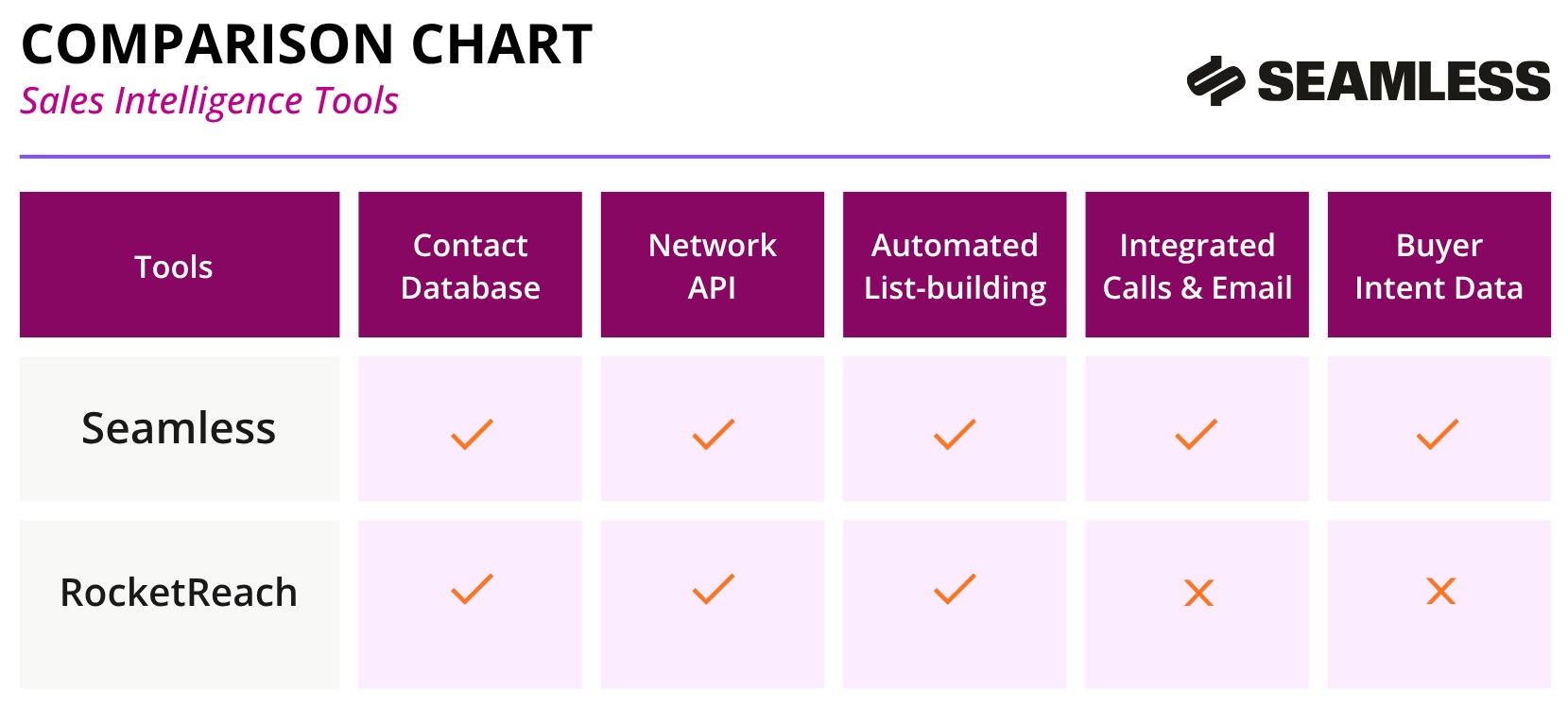
Seamless vs RocketReach Comparison Chart
Pricing and Scalability
Pricing is one of the clearest differences between RocketReach and Seamless.
RocketReach
RocketReach offers published pricing tiers that make it relatively easy for buyers to estimate their expected cost.
Plans increase access to contact data, exports, automation, intent information, and integrations as customers move up the pricing structure.
Pros:
Transparent published pricing
Multiple plan levels
Easy to estimate starting cost
Useful for individuals and smaller teams
Cons:
Export and automation limits vary by plan
Higher usage requires upgrading
Broader functionality can increase total cost quickly
No comparable full-featured free tier
RocketReach's predictable pricing can make it especially appealing to smaller teams or individual users who know exactly how much contact data they expect to consume.
Seamless
Seamless offers Free, Pro, and Enterprise plans, with paid pricing customized around team size and workflow requirements.
Depending on the package, teams can access real-time prospecting, enrichment, Buyer Intent, Autopilot, API access, integrations, Connect, and enterprise support.
Pros:
Free option for testing the platform
Supports both smaller teams and enterprise deployments
Broader workflow functionality can replace multiple point solutions
Designed to scale across prospecting and engagement
Custom plans can align with more complex requirements
Cons:
Paid pricing is less transparent upfront
Teams generally need to speak with sales for a quote
May be more platform than individual users need
RocketReach has an advantage for buyers who value published pricing and predictable contact lookup costs. Seamless becomes more compelling when teams evaluate the cost of the entire prospecting and engagement workflow rather than contact access alone.
Compliance and Data Governance
Compliance and data governance become increasingly important as sales organizations expand across markets and jurisdictions.
RocketReach
RocketReach provides privacy controls and processes for users or individuals who want their information updated or removed.
Its privacy framework supports data requests and opt-out workflows, which can make it workable for teams with established internal compliance processes.
Pros:
Provides profile removal and privacy request processes
Supports data-management controls
Useful for teams with established compliance workflows
Cons:
Teams may need to evaluate regional requirements closely
International compliance requirements can add complexity
Organizations should verify how specific jurisdictions are handled
Seamless
Seamless provides privacy and governance processes designed around major privacy requirements, including GDPR and CCPA.
Users and individuals can submit privacy requests, manage data preferences, and request deletion or removal through Seamless privacy tools.
Pros:
Supports GDPR and CCPA compliance
Provides dedicated privacy-request processes
Designed for broader enterprise deployment
Integrates governance with broader sales intelligence workflows
Cons:
Teams still need their own internal compliance policies
Global organizations may require additional legal review depending on use case
For either platform, businesses should evaluate their own compliance obligations based on where they operate, the data they process, and how prospect information is used.
Which Platform Is Right for Your Team?
While both tools offer similar capabilities, Seamless is the better all-around sales intelligence tool for companies of all sizes. With a larger overall database, more intelligent automation features, and a free tier that lets you try before you buy, Seamless can better support your brand at scale or grow alongside you.
Seamless also doesn't cap your outreach automation like RocketReach, allowing you to increase your outbound volume, contact more potential customers, and meet your growth goals sooner.
Side-by-Side Feature Comparison Table
A good sales platform comparison should make the decision easier, not bury you in feature jargon. The table below gives you a clean, side-by-side view of the areas worth paying attention to before deciding which platform fits your team best.
Feature / Capability
RocketReach
Seamless
Email Data
Provides email data across paid plans
Provides email addresses as part of its prospecting workflow
Phone Data
Phone data is available on higher-tier plans
Includes cell phone data across prospecting workflows
Contact Verification
Uses web crawling and data mining to identify and maintain contact information
Continuously validates and refreshes contact data through its real-time data engine
Data Enrichment
Supports profile and company enrichment across a more limited set of data points
Enriches records across 100+ data points according to the article
List Building
Supports intelligent contact list creation using filters and buyer signals
Supports one-click list building with broad filtering and segmentation options
Firmographic Filtering
Filters by company name, domain, employee count, industry, revenue, intent, and related criteria
Includes common firmographic filters plus additional signals such as growth trends, tech stack, products, and company structure
Buyer Intent
Available on higher-tier plans
Available through Buyer Intent capabilities
AI Writing Assistance
Includes AI-assisted messaging within Autopilot workflows
Supports AI-assisted outreach and messaging within broader prospecting and engagement workflows
Workflow Automation
Autopilot can automate list generation, outreach, follow-ups, templates, and time-based rules
Supports automated prospecting, outreach, follow-up, and nurturing through Autopilot and Connect
Multi-Channel Engagement
Primarily centered on email-based outreach and automation
Connect supports email, calling, and social selling workflows
Integrations
Integrates with popular platforms such as Salesforce and HubSpot
Offers thousands of native and Zapier-based integrations
CRM Integration
Supports integrations with major CRMs and custom mapping on higher-tier plans
Supports CRM connectivity, enrichment, and broader workflow integration
Free Plan
No free plan according to the article
Offers a free tier with prospecting features and credits
Export Limits
Annual export limits vary by plan, from 1,200 to 20,000 according to the article
Pro includes unlimited data exports according to the article
API Access
Not emphasized as a core feature in the article
Available with Enterprise plans
Scalability
Supports larger organizations but places usage limits on certain automation and export features
Designed to support growing teams with broader prospecting, automation, and enterprise capabilities
Best Fit
Teams focused on contact lookup, list building, and structured outreach automation
Teams looking for a broader prospecting, enrichment, engagement, and pipeline-generation platform
There’s a clear winner in the showdown between Seamless vs RocketReach. With a larger database, expanded AI sales prospecting features, and greater depth of data, Seamless simply offers more and outperforms RocketReach across almost every task.
RocketReach does offer more clarity in pricing, with clearly defined tiers to choose from. But the custom costs of Seamless give you the features and access you truly need at a cost tailored for you, rather than forcing you to overpay for options you don’t use.
Supercharge your B2B sales prospecting with verified data and real-time insights. Leverage Seamless for powerful, prolonged pipeline growth.
What is the main difference between Seamless and RocketReach?
The main difference between Seamless and RocketReach is the breadth of the sales workflow each platform supports. RocketReach focuses on contact discovery, company data, and list building. Seamless supports a larger portion of the prospecting workflow, from enrichment to buyer intent and automation.
Which has better contact/company coverage: RocketReach or Seamless?
Seamless has better contact and company coverage than RocketReach for teams that need broader prospecting data. Seamless combines real-time contact discovery with firmographic, company, and account intelligence, while RocketReach is more focused on contact lookup and company research.
Coverage can still vary by industry, geography, and ICP.
Which has a larger contact database: Seamless or RocketReach?
RocketReach reports 700 million contacts, while Seamless.AI is not a contact database.
Compared to a contact database that loses 22.5%-70% accuracy within a year, Seamless.AI verifies contact data in real time, ensuring data is fresh. Seamless.AI has validated approximately 1.3 billion contacts to date.
Which is better for building B2B prospect lists?
Seamless.AI is better for building B2B prospect lists because it combines large-scale search, automation, and AI integrations in one workflow. Teams can use tools like ChatGPT and Claude alongside Seamless to generate targeted lists with hundreds or thousands of leads faster and with less manual research.
Which has more accurate emails and phone numbers: RocketReach or Seamless?
Seamless is better suited for teams that want real-time verified emails and phone numbers, while RocketReach also provides verified contact data. Seamless continuously searches for current contact information as users prospect, helping reduce stale records and improve data freshness.
Accuracy can still vary by role, industry, geography, and target market.
Is Seamless accurate?
Yes, Seamless is accurate for finding and verifying B2B contact and company data in real time. The platform searches for current business emails, phone numbers, and company details as users prospect, helping improve overall data quality.
No B2B data provider is 100% accurate because business information changes constantly.
RocketReach. How accurate is RocketReach's data?. https://knowledgebase.rocketreach.co/hc/en-us/articles/235187087-How-accurate-is-RocketReach-s-dat.
RocketReach. What Data is Available on PersonaProfiles?. https://knowledgebase.rocketreach.co/hc/en-us/articles/26545133272987-What-Data-is-Available-on-Person-Profiles.
RocketReach. What Data is Available on Company Profiles?. https://knowledgebase.rocketreach.co/hc/en-us/articles/26545133272987-What-Data-is-Available-on-Person-Profiles.
RocketReach. How often does RocketReach update data?. https://knowledgebase.rocketreach.co/hc/en-us/articles/17470432040347-How-often-does-RocketReach-update-data.
RocketReach. How do I Update my Information on RocketReach. https://knowledgebase.rocketreach.co/hc/en-us/articles/33964124586139-How-do-I-Update-my-Information-on-RocketReach.
Sales intelligence and prospecting expert with years of experience to help sales teams grow and hit quota. Voted one of the top startups in America and rated as the highest software in Customer Satisfaction from G2 best software awards in 2025. Join our Reddit community for more product updates and sales tips. https://www.reddit.com/r/Seamless_AI/