Kaspr vs. Seamless: Comparing Lead Generation Tools
Seamless Team
July 14, 2026
This article is a comparison of Kaspr vs Seamless.AI, two sales prospecting platforms designed to help teams find prospects, access contact data, and move potential buyers into the pipeline.
Picture this...Your team has identified a promising target account. The buying committee is mapped, outreach is ready to go, and now there’s just one question left: Do you have the right data to start the conversation?
With an ocean of data now available to sales reps, quality often determines whether a rep spends their day having conversations or chasing dead ends. Beyond providing names and email addresses, the right lead generation platform should help your team discover opportunities and confidently move prospects into the pipeline.
In this comparison piece, we’ll take a closer look at how Kaspr vs Seamless AI approach lead generation, prospect discovery, data accuracy, workflow automation, and sales execution so that you can choose the best platform for your team.
TL;DR
Kaspr vs. Seamless.AI Verdict: Kaspr is a strong option for solopreneurs and smaller teams that need LinkedIn-based prospecting and quick contact retrieval. But Seamless comes out on top for teams that need a more complete sales prospecting platform, combining contact and company search, enrichment, account intelligence, automation, and pipeline-building capabilities in one workflow. Ultimately, for orgs looking to scale prospecting beyond LinkedIn and cut back on tech stack tools, Seamless is the stronger overall choice.
Overview of Kaspr vs Seamless AI
Both Kaspr and Seamless help sales teams find the right people to contact and get accurate information into reps' hands faster. But what makes them distinct?
Here are a few core differences between Kaspr and Seamless
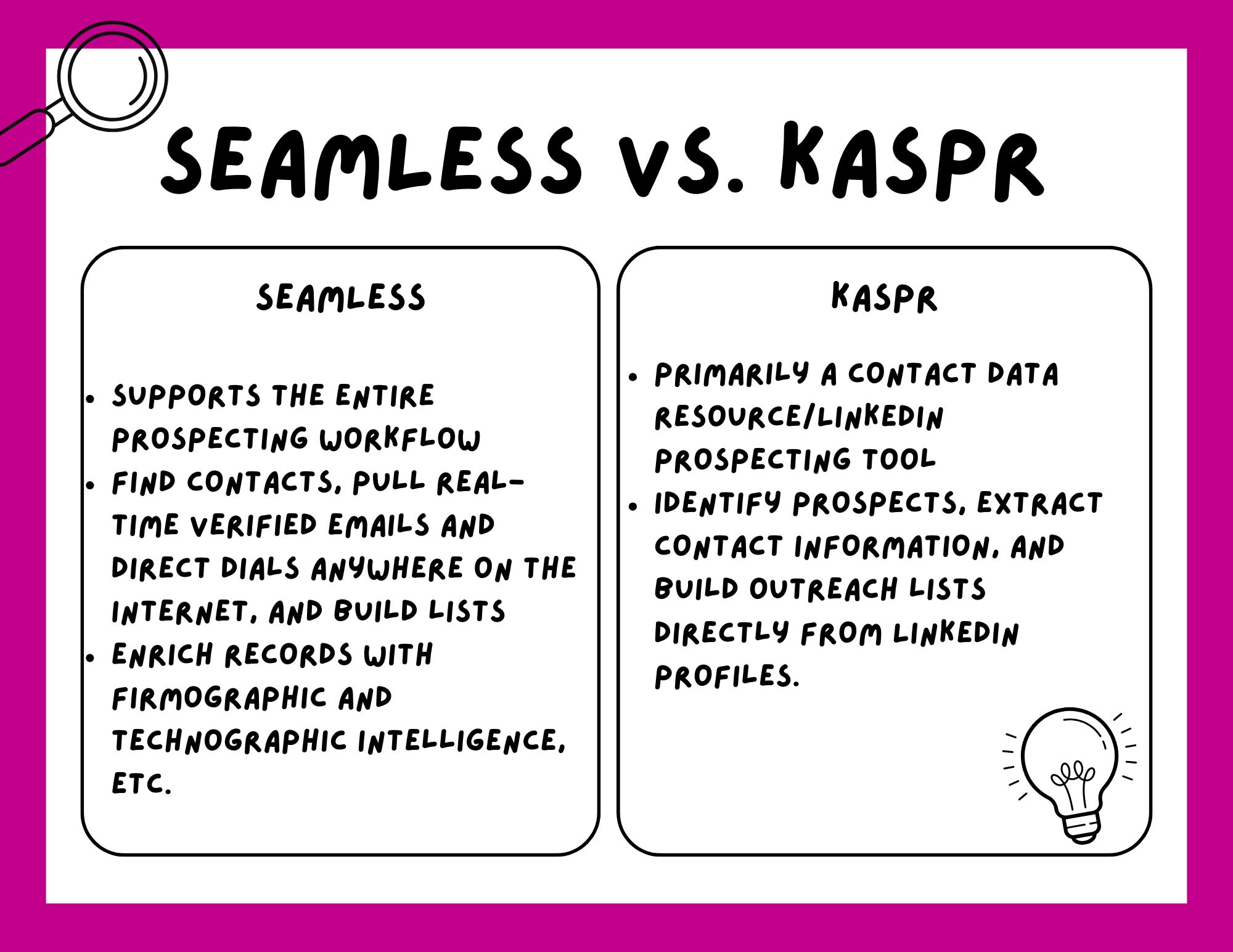
Kaspr is primarily known as a contact data and LinkedIn prospecting tool. It helps users identify prospects, extract contact information, and build outreach lists directly from LinkedIn profiles. For teams focused on individual prospect discovery and day-to-day outbound activity, Kaspr offers a straightforward way to transition from profile research to contact acquisition.
Seamless helps teams discover contacts, enrich records with firmographic, technographic, and account-level intelligence, and prioritize opportunities based on more than basic contact information. Rather than functioning solely as a data source, Seamless takes a broader approach to sales execution and supports the entire prospecting workflow from lead to deal.
When dollars are limited, teams need more context to determine where to invest effort. For example, a solo sales development representative (SDR) looking for contact details may evaluate a platform differently than a revenue organization managing thousands of accounts across multiple territories. This is why we decided to put this article together, to provide helpful context in comparing Seamless and Prospeo.
Core Features Compared
Both Kaspr and Seamless help sales teams find prospects and contact decision-makers at a glance. But let’s dive deeper into each platform’s core features.
Here's what a day with Kaspr looks like
The Prospecting Workflow
Kaspr
A typical Kaspr workflow starts inside LinkedIn or Sales Navigator. A rep identifies a prospect, opens the profile, and uses the Kaspr Chrome extension to reveal available contact information. From there, the contact can be exported into a CRM or sales engagement platform for outreach.
This workflow is especially useful for SDRs, recruiters, founders, and individual sellers who already spend a significant amount of time researching prospects manually on LinkedIn.
Pros:
Simple LinkedIn-first workflow
Fast contact retrieval from individual profiles
Easy for individual reps to learn and use
Useful for sellers who already prospect heavily in Sales Navigator
Cons:
Prospect discovery is heavily dependent on LinkedIn
Building large, targeted prospect lists may require more manual research
Less suited to teams that want to search and segment entire markets directly inside the platform
Seamless
The centerpiece of the Seamless workflow is our contact/company search
Imagine a sales team tasked with building a list of 1,000 operations leaders at manufacturing companies with 200 to 1,000 employees (McKinsey & Company). A Kaspr user will likely spend much of that process identifying prospects through LinkedIn searches, whereas a Seamless user can build much of that list directly inside the platform.
Rather than search high and low on social platforms for dream clients, input the criteria you’re looking for in the Seamless search engine. And if you don’t want to be bothered with re-thinking the Boolean method, you can tell us what your dream client looks like directly within our AI search. Then enrich and prioritize it before outreach begins. Rather than search exclusively on LinkedIn and just hope for the best, with Seamless, you take your contact search and your company searches into your own hands.
Seamless treats contact accuracy as part of an ongoing prospecting workflow. In addition to finding contact information, teams can enrich records with role information and account intelligence. This gives reps additional context around the people and organizations they are targeting rather than treating each contact lookup as an isolated event.
Pros:
Combines contact discovery and enrichment
Adds company and account-level intelligence
Helps teams maintain more complete prospect records
Supports role-change and account research workflows
Useful for teams managing large prospect databases
Cons:
More data and functionality can create a steeper learning curve for new users
Teams seeking only basic contact lookup may not need the full feature set
Contact Data Accuracy and Verification
Most platforms can find an email address, but they can’t determine whether that email still belongs to the right person at the right company (ResearchGate). This is because contact data is one of the most misunderstood aspects of prospecting software.
Contact data loses value quickly when people change roles, companies, phone numbers, or email addresses. The key difference between Kaspr and Seamless is how each platform approaches keeping prospect information useful throughout the sales process.
Kaspr
Kaspr helps users retrieve and enrich contact information directly from LinkedIn profiles. Sellers can access available emails and phone numbers while researching prospects and move that information into their sales workflow.
For individual sellers who primarily need contact details for prospects they have already identified, this can provide a fast path from research to outreach.
Pros:
Contact information available directly from LinkedIn workflows
Supports email and phone number discovery
Straightforward enrichment process
Well suited for one-to-one prospect research
Cons:
Contact discovery often begins with the rep identifying the prospect first
Provides less account-level context than a broader sales intelligence platform
Less focused on continuous account and prospect intelligence
Seamless
Seamless treats contact accuracy as part of an ongoing prospecting workflow. In addition to finding contact information, teams can enrich records with company data, role information, and account intelligence.
This gives reps additional context around the people and organizations they are targeting rather than treating each contact lookup as an isolated event.
Helps teams maintain more complete prospect records
Supports role-change and account research workflows
Useful for teams managing large prospect databases
Cons:
More data and functionality can create a steeper learning curve for new users
Teams seeking only basic contact lookup may not need the full feature set
LinkedIn Prospecting and Chrome Extension Features
LinkedIn remains one of the most common resources for B2B prospecting, making browser-based prospecting functionality an important consideration when comparing Kaspr and Seamless.
These are a few tasks you can run with Kaspr's Chrome extension
Kaspr
Kaspr is heavily optimized for LinkedIn prospecting. Its Chrome extension allows users to reveal contact information while browsing LinkedIn profiles and Sales Navigator results.
A typical workflow includes searching Sales Navigator, opening a prospect profile, retrieving contact details, exporting the prospect, and adding that person to an outreach sequence.
Pros:
Strong LinkedIn-first experience
Quick contact retrieval from individual profiles
Works naturally alongside Sales Navigator
Reduces manual copying and data entry
Straightforward workflow for LinkedIn-heavy sellers
Cons:
Prospecting experience is closely tied to LinkedIn
Less useful for teams that want to build lists outside of social platforms
Account research and enrichment capabilities are narrower than a full sales intelligence platform
Seamless
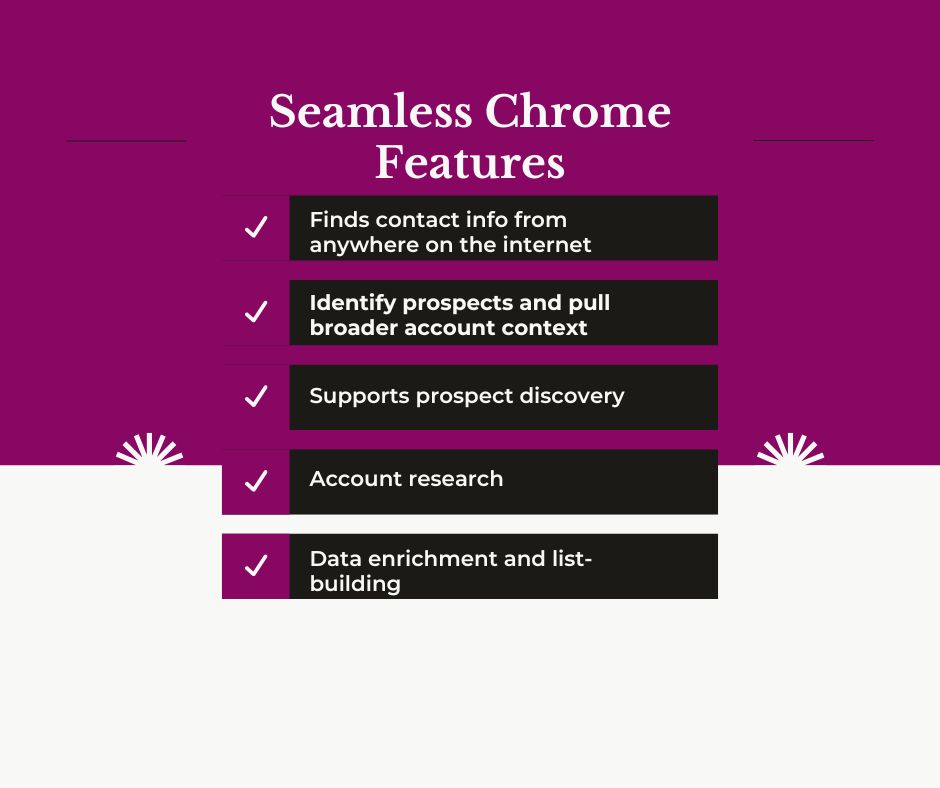
Seamless also offers a Chrome extension, but the workflow extends beyond retrieving individual contact details. Reps can use it to discover prospects, research accounts, enrich records, and add contacts to lists while browsing the web.
This can be useful when a buying committee has multiple stakeholders and the rep needs broader context around both the individual and the account.
Our Chrome extension is our pride and joy. It makes our platform... seamless
Pros:
Supports contact discovery directly from the browser
Combines prospecting with account research
Helps reps enrich records while they browse
Supports list building and broader prospecting workflows
Useful for multi-threaded account prospecting
Cons:
More functionality can make the extension feel broader than necessary for users who only want contact retrieval
New users may need time to learn the full workflow
Ease of Use and Integrations
Ease of use depends heavily on what a team expects the platform to accomplish. Kaspr offers a narrower, more focused workflow, while Seamless provides a broader set of sales intelligence and workflow capabilities.
Kaspr
Kaspr keeps most of its experience centered around contact discovery, enrichment, and export. Users can install the Chrome extension, connect their LinkedIn workflow, and begin researching prospects quickly.
Pros:
Focused interface
Fast setup for LinkedIn prospecting
Relatively simple learning curve
Easy to understand for individual sellers
Cons:
Narrower workflow compared with broader sales intelligence platforms
Teams may still need additional tools for account research, intent, enrichment, or automation
Less suited to complex revenue operations environments
Seamless
Seamless supports prospect discovery, enrichment, account intelligence, buyer signals, CRM workflows, and thousands of integrations.
That broader functionality can require more onboarding upfront, but it also gives revenue teams the ability to consolidate more of their prospecting and data workflows into one platform.
Teams can connect Seamless directly with major CRMs including Salesforce, HubSpot, Microsoft Dynamics 365, Pipedrive, Zoho CRM, and Keap, allowing reps to move researched contacts and companies into the systems where their pipeline already lives.
Depending on the integration, teams can map Seamless fields to CRM fields, control whether new data overwrites existing values, reduce duplicate records, and route imported contacts or companies into the appropriate lists, campaigns, or workflows.
For sales engagement, Seamless connects with platforms including Salesloft, Outreach, and Mixmax. For example, the Salesloft integration can enrich existing contact records with verified emails and phone numbers, add company and buying-signal data, and bulk import prospect lists so reps can move directly from research into cadence execution.
Seamless also connects with automation tools like Zapier, Make, n8n, ChatGPT, and Claude, giving revenue teams more flexibility to build workflows across their GTM stack. Through Zapier, for example, a newly researched contact can be enriched in Seamless, pushed into a CRM, added to a Google Sheet or marketing workflow, or used to trigger a notification in another application.
For HubSpot users specifically, Seamless can import contact information directly into the CRM, enrich existing records with additional company and contact data, customize field mappings, set match thresholds to help avoid duplicates, and add more than 100 data points that can be incorporated into lead-scoring and prioritization workflows.
That broader connectivity can require more onboarding upfront, but it also gives revenue teams the ability to consolidate more of their prospecting, enrichment, CRM, and sales-engagement workflows instead of constantly moving data between disconnected tools.
Pros:
6,000+ integrations
Supports CRM and sales workflow connectivity
Combines multiple prospecting and intelligence functions
Can reduce dependence on separate prospecting tools
Better suited for larger and more complex sales organizations
Cons:
Broader functionality can require additional training
Setup may take longer for teams using advanced integrations and workflows
Pricing and Scalability
Kaspr and Seamless take different approaches to pricing. Kaspr emphasizes fixed self-service plans, while Seamless offers broader packages designed around different team sizes and prospecting requirements.
Kaspr
Kaspr publishes fixed monthly pricing for its paid plans, making it easy for individual sellers and small teams to estimate costs upfront (Kaspr).
Its starter plan begins at $49 per user per month and includes unlimited B2B email credits, 1,200 annual phone credits, 60 annual direct email credits, and up to 12,000 exports per year. Its Business plan increases the available phone, email, and export allowances.
Pros:
Publicly listed pricing
Straightforward for individuals and smaller teams
Easy to estimate contact acquisition costs
Useful for organizations primarily focused on LinkedIn prospecting
Cons:
Credit and export limits can become more important as usage grows
Teams may still need to purchase additional tools for broader account research and workflow needs
Manual prospect research can add indirect labor costs as teams scale
Seamless
Seamless uses a more customizable pricing model designed around team size, feature requirements, data needs, and usage.
We also use universal credits that can be applied across capabilities such as buyer intent data, enrichment, and Autopilot. Enterprise plans can include additional services and controls such as dedicated customer success support, quarterly business reviews, phone support, advanced administration, and unlimited-user configurations.
Seamless also offers a free plan with 50 credits, while paid plans can be tailored based on the needs of the organization.
Pros:
Pricing can be aligned with team size and usage requirements
Universal credits can be used across multiple platform capabilities
Seamless supports both smaller teams and enterprise deployments
Enterprise options include additional support and administration features
The platform is designed to scale across broader prospecting workflows
Cons:
Paid pricing is less immediately transparent than a fixed self-service plan
Teams may need to speak with Seamless to determine the right package
Broader capabilities may exceed the needs of sellers looking only for basic contact retrieval
Pros and Cons of Each Platform
No prospecting platform is perfect for every team. Understanding where each solution excels (and where it may fall short) can help you choose the platform that best aligns with your sales process.
Kaspr pros and cons
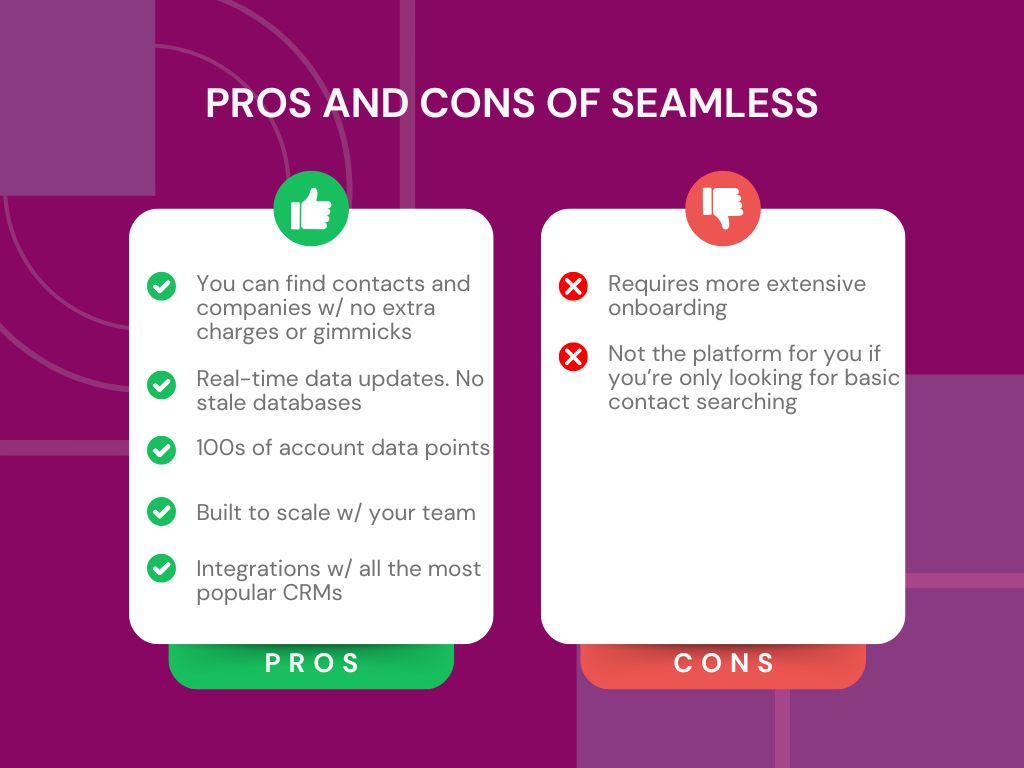
Seamless pros and cons
Which Tool Should You Choose?
The right choice between Kaspr vs Seamless AI depends on what problem you're trying to solve.
If your team spends most of its prospecting time inside LinkedIn, manually identifying prospects and pulling contact information one profile at a time, Kaspr may be the better fit. Its streamlined Chrome extension and LinkedIn-first workflow make it particularly attractive for smaller sales teams that prioritize speed.
But if your team needs a broader prospecting motion, Seamless is the better choice because you can search for companies and decision-makers, enrich records with company intelligence, build targeted lists, and prioritize outreach based on real-time information: all within a single workflow.
The budget should also be evaluated in context. A lower-cost tool that requires additional manual research, enrichment, and list building may appear less expensive initially, but if reps spend hours each week filling gaps between systems, those costs eventually surface elsewhere in the sales process. The more pipeline a team is expected to create, the more valuable enrichment becomes.
Put simply:
Choose Kaspr if your priority is LinkedIn-based prospect discovery and straightforward contact acquisition.
Choose Seamless if you're looking for a platform that supports prospect discovery, enrichment, prioritization, and pipeline creation at scale.
Side-by-Side Feature Comparison Table
When two platforms seem similar at first glance, the most useful differences tend really become clear once you compare how they support the actual work reps do every day. The table below gives you a side-by-side view of the areas that matter most when evaluating which option fits your sales motion.
Feature / Capability
Kaspr
Seamless
Chrome Extension
Reveals contact information directly from LinkedIn profiles and Sales Navigator
Supports prospect discovery, account research, enrichment, and list building from the browser
Email Data
Provides B2B email addresses and direct email credits
Provides real-time contact data as part of the prospecting workflow
Phone Data
Provides phone numbers using allocated phone credits
Provides phone data alongside broader contact and account intelligence
Contact Verification
Supports contact enrichment and verification during prospecting
Treats verification as an ongoing process with continuously enriched contact and company data
Data Enrichment
Enriches records as users identify prospects
Continuously enriches records with firmographic, technographic, contact, and account-level intelligence
Company Intelligence
Primarily supports prospect-level research and contact acquisition
Adds broader company and account intelligence to help reps evaluate opportunities
Lead / Account Prioritization
More focused on finding and exporting individual prospects
Helps teams prioritize opportunities using account intelligence and buyer signals
List Building
Builds outreach lists from LinkedIn and Sales Navigator prospecting
Supports building larger targeted company and contact lists directly within the platform
Buyer Signals
Not positioned as a primary differentiator in the article
Incorporates buyer signals into prospect prioritization and workflow decisions
Sales Engagement Workflow
Contacts are typically exported into CRM or engagement platforms for outreach
Designed to move reps from discovery and enrichment toward outreach within a broader prospecting workflow
Integrations
Connects prospecting activity with CRM and outreach tools
Offers 6,000+ integrations according to the article, supporting a broader revenue tech stack
Ease of Use
Focused workflow makes it relatively quick for new users to begin prospecting
Broader functionality requires more onboarding but can reduce reliance on separate tools
Tool Consolidation
Often works alongside separate research, enrichment, and outreach tools
Designed to consolidate more of the prospecting workflow into one platform
Entry-Level Pricing
Starter plan begins at $49 per user per month according to the article
Free plan includes 50 credits; paid plans are typically customized
Exports
Starter includes up to 12,000 annual exports; Business includes up to 30,000 according to the article
Export availability is packaged within broader Pro and Enterprise workflows
Scalability
Well suited to individual sellers and smaller teams with LinkedIn-heavy workflows
Designed for larger or growing teams managing more complex prospecting motions and account volumes
Best Fit
SDRs, recruiters, founders, and smaller teams focused on LinkedIn-based prospect discovery
Revenue teams looking to combine prospect discovery, enrichment, prioritization, and pipeline creation at scale
Sales teams are no longer competing on activity alone. Speed of execution and accuracy are the new competitive advantages (McKinsey & Company).
While both Kaspr and Seamless help sales teams connect with prospects, Seamless is built with a larger goal in mind: turning prospecting into a repeatable growth engine. From real-time contact discovery and enrichment to account intelligence and workflow support, every part of the platform is designed to help reps spend less time searching and more time selling.
At Seamless, we believe great prospecting starts with great data. But it doesn't end there. The real advantage comes from knowing who to contact, when to engage them, and which opportunities deserve attention first.
If your team is ready to move beyond contact acquisition and build a more predictable pipeline generation process, reach out to learn more about how Seamless can help.
Frequently Asked Questions: Kaspr vs. Seamless
What is the main difference between Kaspr and Seamless?
The main difference between Kaspr and Seamless is the scope of their prospecting workflows. Kaspr focuses on LinkedIn-based prospecting and contact data retrieval. Seamless supports contact discovery and helps sales teams search for target accounts, enrich records, identify decision-makers, prioritize prospects, automate prospecting activities, and build pipeline at scale.
Is Kaspr or Seamless better for sales prospecting?
Seamless is better suited for teams that need a broader sales prospecting platform. Reps can search for leads based on their ideal customer profile, build targeted lists, enrich prospect information, and prioritize opportunities. Kaspr may be a better fit for smaller teams whose prospecting workflow is centered primarily around LinkedIn.
Is Kaspr an alternative to Seamless?
Yes, Kaspr can be considered an alternative to Seamless for LinkedIn prospecting and B2B contact discovery. However, the platforms serve different needs. Kaspr specializes in retrieving contact information from LinkedIn, while Seamless supports a broader prospecting workflow that includes account discovery, contact search, enrichment, prioritization, automation, and sales execution.
Which is better for finding B2B leads: Kaspr or Seamless?
Seamless is better suited for broader B2B lead generation because teams can search directly for leads using criteria such as industry, employee count, geography, revenue, and job title. Kaspr works particularly well when a rep has already identified a prospect on LinkedIn and needs to retrieve that person's contact information.
How do Kaspr and Seamless compare for contact data accuracy?
Kaspr and Seamless provide B2B contact information and data enrichment capabilities. Kaspr helps users retrieve and enrich contact information as part of a LinkedIn-based prospecting workflow. Seamless combines contact discovery with real-time search, verification, enrichment, and account intelligence to help teams maintain current prospect data throughout the sales process.
Is Seamless accurate?
Yes, Seamless.AI is accurate. Seamless.AI finds business emails, company details, and other prospect information in real time.
No B2B database is 100% accurate because contact information changes constantly. But Seamless.AI helps reduce stale data by verifying and refreshing information as users search.
Sales intelligence and prospecting expert with years of experience to help sales teams grow and hit quota. Voted one of the top startups in America and rated as the highest software in Customer Satisfaction from G2 best software awards in 2025. Join our Reddit community for more product updates and sales tips. https://www.reddit.com/r/Seamless_AI/