6sense vs. Seamless Comparison Report - GTM Platform Guide
Sidney Jones
March 20, 2026
This article compares 6sense vs. Seamless for sales prospecting, including how the two platforms differ across contact discovery, buyer intent, data enrichment, automation, pricing, and go-to-market workflows.
Choosing the right go-to-market platform can make or break your pipeline strategy.
On the surface, 6sense and Seamless may seem like they serve similar purposes since they both help teams identify buyers and drive revenue. But when we did a side-by-side comparison, we noticed some big differences in lead quality, accuracy, and coverage that might play a part in your decision-making if you’re in the market for a new go-to-market tool.
Keep scrolling, and let’s take a closer look to see how 6sense stacks up against Seamless.
TL;DR
Seamless is the better choice for teams focused on sales prospecting, contact discovery, list building, enrichment, and outbound execution. While 6sense is better suited for account-based marketing, buyer intent, predictive analytics, and GTM orchestration.
6sense excels at helping teams identify and prioritize in-market accounts, but Seamless is more directly built for turning prospect data into pipeline.
For sales-led teams that need to prospect quickly and consistently, Seamless offers the more streamlined workflow.
Pricing
Both 6sense and Seamless use credit-based pricing, but the structure and buying experience differ.
6sense
6sense uses data credits for contact and company exports, while broader pricing can depend on package mix, AI functionality, integrations, advertising usage, and media spend. Public pricing is limited for several of its paid offerings, so buyers may need to speak with sales to understand total cost.
Pros:
Free plan available
Flexible packaging across sales, marketing, and advertising use cases
Supports predictive AI, buyer intent, workflows, and advertising
Can scale well for enterprise ABM programs
Cons:
Paid pricing is not always transparent
Packaging can be difficult to compare across plans
Total cost can vary based on data, AI, integrations, and advertising
Broader functionality may be more than sales-only teams need
6sense can fall short for buyers who want a simple, sales-first pricing structure and a clear path from prospect search to outreach. Its packaging is better suited to larger organizations that need account intelligence, predictive modeling, advertising, and broader GTM orchestration.
That complexity is also why 6sense remains a strong fit for its target customer. Mid-market and enterprise teams running mature account-based marketing programs may value the ability to combine intent, predictive analytics, advertising, and workflow orchestration in one platform.
Seamless
Seamless uses Standard Credits for lead searches and Universal Credits for premium functionality such as Autopilot, AI Assistant, and Data Enrichment.
The platform offers Free, Pro, and Enterprise plans, allowing teams to start with basic prospecting and expand into more advanced enrichment, intent, automation, and API workflows.
Pros:
Free plan available
Clear progression from Free to Pro to Enterprise
Credits support both contact discovery and premium workflows
Includes sales-focused functionality such as Autopilot, Buyer Intent, and Connect
Better suited for teams that want prospecting and execution in one platform
Cons:
Paid pricing is customized rather than fully published
More advanced capabilities may require higher-tier plans
Credit usage still needs to be managed
For sales-led teams, Seamless offers a more direct path from finding prospects to enriching records and beginning outreach.
6sense core features vs. Seamless
6sense vs Seamless Data Coverage and Verification
The two platforms also differ in how they collect, organize, and surface data.
6sense
6sense uses its Signalverse intelligence network to process large volumes of firmographic, technographic, behavioral, and intent data.
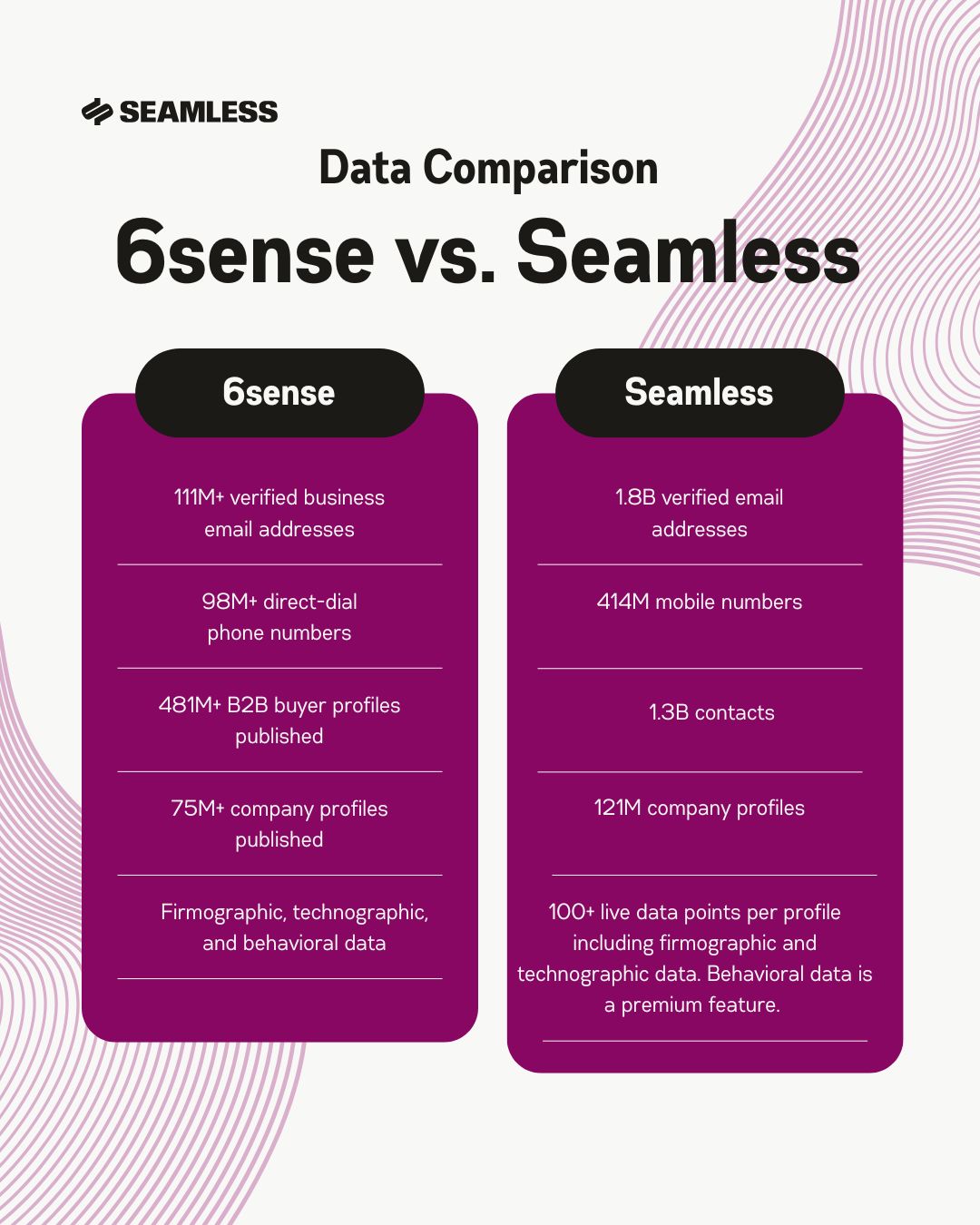
Its published coverage includes hundreds of millions of buyer profiles, company profiles, direct-dial phone numbers, and verified business email addresses. Signalverse also incorporates first-party interactions, third-party intent, and account-level signals.
Pros:
Large-scale buyer and company intelligence
Strong behavioral and intent data
Combines firmographic, technographic, and account signals
Well suited for account prioritization
Valuable for ABM and predictive analytics
Cons:
Less focused on real-time contact discovery
Contact freshness may be harder to evaluate
Better suited for account intelligence than rep-level prospecting speed
Can require additional systems for day-to-day outbound execution
6sense is strongest when the goal is to understand which accounts may be in-market and how buying activity is changing across an account.
Where it can fall short is at the individual rep level. A salesperson who needs fresh phone numbers, emails, and contact records immediately may find the experience less direct than a platform built primarily around prospecting.
Seamless
Seamless uses a real-time search engine to find and verify contact and company data as users prospect.
Its Prospector combines publicly available information with third-party sources, integrations, and additional intelligence to provide more than 100 live data points across contacts and companies.
Pros:
Real-time contact discovery and verification
Large volume of researched contacts, emails, mobile numbers, and companies
100+ live data points
Strong fit for rep-level prospecting
Includes firmographic, technographic, job change, and buyer-intent data
Cons:
Coverage can still vary by market, role, and geography
Some hard-to-reach senior contacts may be less consistent
Teams need to define filters carefully to avoid overly broad searches
For outbound teams, Seamless is designed to make contact data immediately actionable rather than stopping at account-level intelligence.
6sense/Seamless data comparison
Reviews for 6sense vs Seamless
6sense Reviews
We looked at 6sense customer testimonials on every major review site, from G2 to Reddit.
6sense maintains a 4.1 out of 5 on G2 with 2,204 reviews. They’ve earned 100+ badges on G2, including being named a leader across 11 categories in G2’s Summer 2024 rankings.
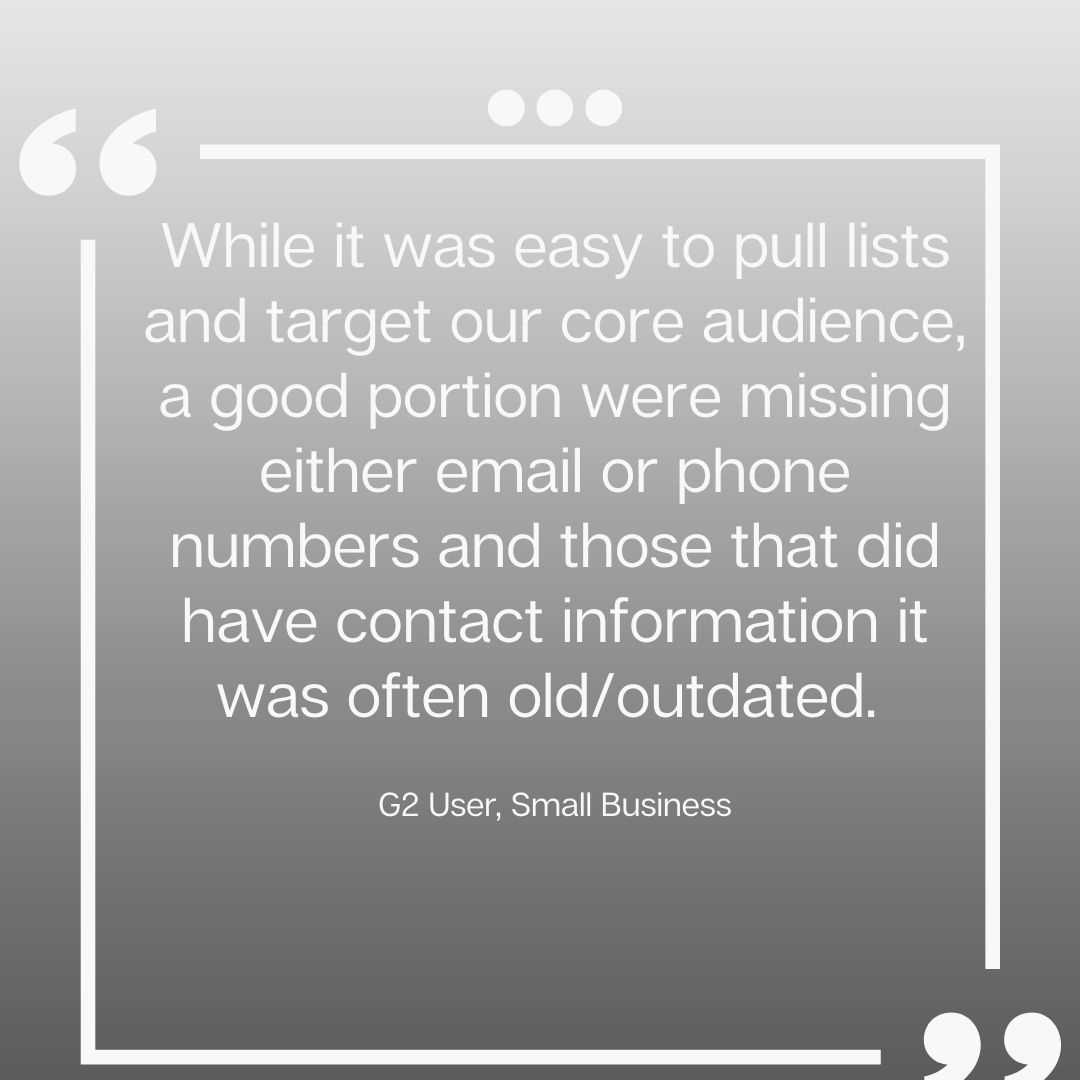
A core complaint we noticed is that 6sense promises high-value intent and prospecting intelligence, but many users feel the data they find is too inaccurate, incomplete, and stale to trust for effective sales execution.
Data is often unreliable or outdated. Reviewers mention constantly coming across incorrect company details (i.e., company size, etc.), non-existent companies, and bad contact data.
Many reviewers feel 6sense does a poor job of identifying which leads are actually worth pursuing. “Hot” accounts, active buyers, and intent signals often don’t translate into meetings or pipeline.
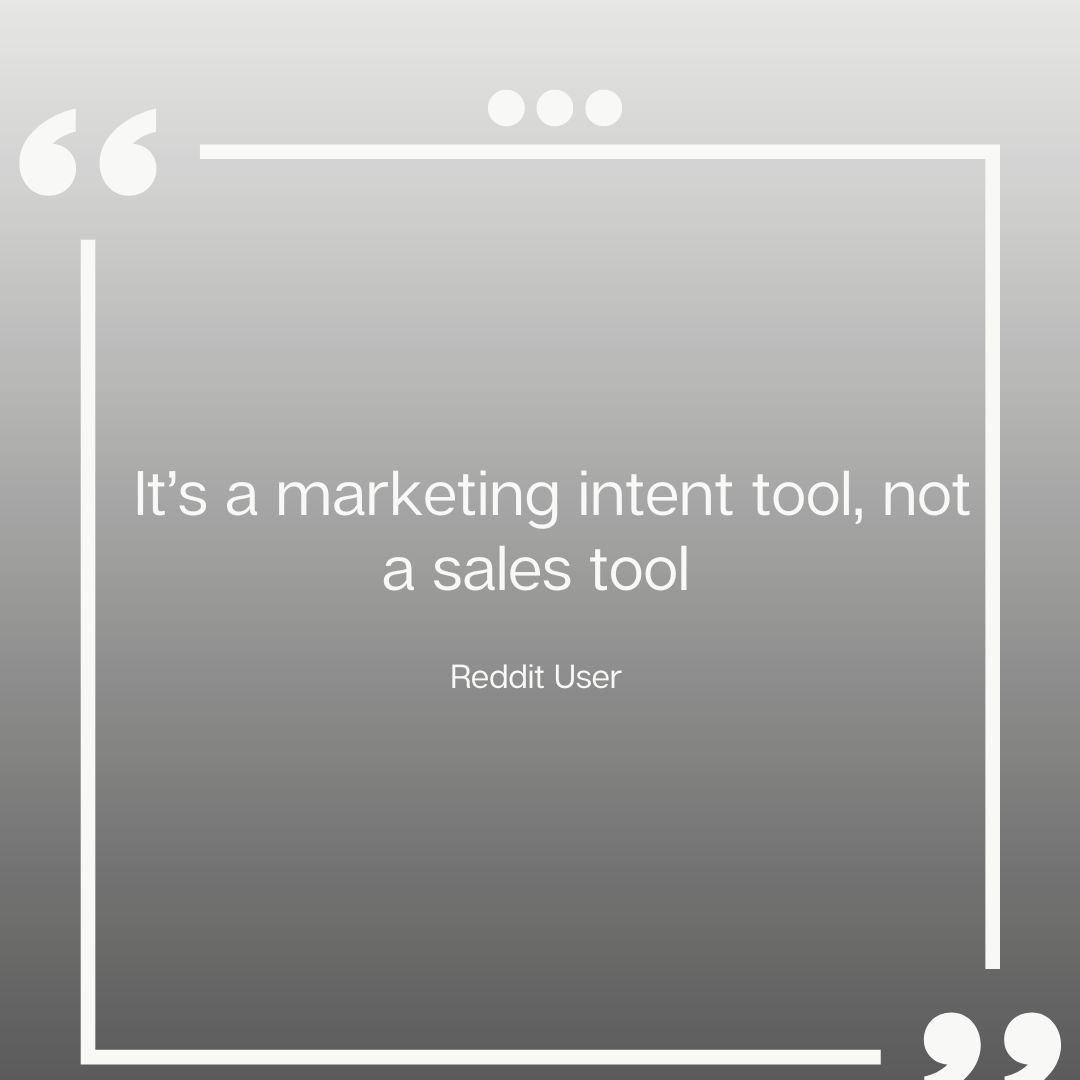
Several comments suggest 6sense actually works better as a broad marketing intent tool than a sales prospecting tool. Users expected actionable sales intelligence, but instead got weak lead prioritization and unreliable outreach data.
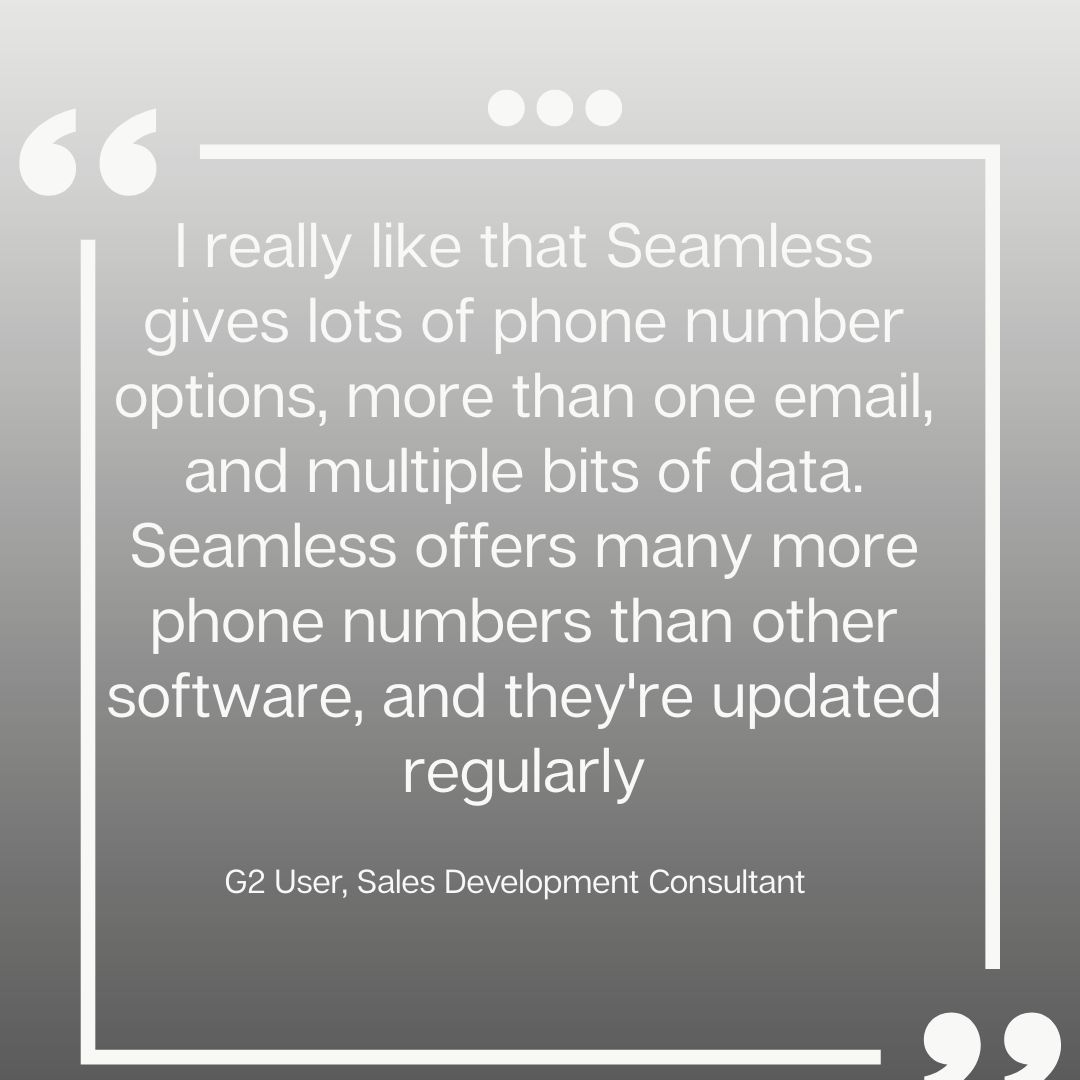
Across review platforms, Seamless gets consistently recognized for speed, having a streamlined interface that’s easy to use, filtering that allows for deep insights, and real-time enrichment.
Our platform’s innovative use of AI-powered real-time data verification is one of our biggest competitive differentiators. Reviewers note that Seamless’ fresh data helps improve deliverability, lower bounce rates, and less manual research (the tedious, busy work no one wants to do).
Strong filtering and targeting are additional strengths that users point out as they like being able to drill down on any specific industry, role, and geography, or keep searches broad for larger prospect pools.
Occasional bugs and platform performance issues were mentioned as pain points, and senior-level contacts can be inconsistent if you’re hunting for a hard-to-reach decision-maker or you’re targeting markets that aren’t very active.
Product Support
Both platforms offer self-service resources and customer support, but their support models differ.
6sense
6sense provides a Knowledge Base, community resources, training through 6sense Academy, system-status tools, and direct support channels.
That gives customers multiple ways to solve issues, particularly for organizations with technical teams that can manage more complex implementations.
Pros:
Extensive Knowledge Base
Dedicated learning through 6sense Academy
Community support
Multiple support channels
Strong fit for enterprise implementations
Cons:
Reviewers sometimes describe support consistency as uneven
Complex implementations can require more hands-on assistance
Customer success experiences may vary
Larger platform scope can increase onboarding complexity
6sense may require more enablement because the platform spans sales intelligence, intent, predictive analytics, advertising, and orchestration. For larger organizations with dedicated Marketing Ops or RevOps resources, that tradeoff can be worthwhile.
Seamless
Seamless offers a self-service education library, step-by-step product guidance, chat support, and Customer Success support.
Customers can use the Knowledge Base for common workflows or work with Customer Success on onboarding, CRM setup, prospecting strategy, and more customized use cases.
Pros:
Extensive self-service education
Dedicated Customer Success support
Chat-based help available
Onboarding designed around sales workflows
Guidance can be tailored to team size and use case
Cons:
More advanced CRM and automation setups can still require assistance
Larger teams may need additional enablement
Support needs can increase as workflows become more customized
For sales teams that want faster onboarding and more direct help around prospecting workflows, Seamless offers a more sales-focused support experience.
Side-by-Side Feature Comparison Table
When two GTM platforms both promise to help teams find and act on opportunities, the real differences can get buried in the details. The table below puts the most important areas side by side so you can evaluate each platform and choose the one that works how your team works.
Feature
6sense
Seamless
Contact Discovery
Available through sales intelligence and buyer data tools
Core prospecting capability with real-time contact search
Company Discovery
Strong account and company intelligence
Company search with firmographic and account-level data
Email & Phone Data
Provides verified business emails and direct dials
Real-time verified emails, cell phones, and direct dials
Data Verification
Uses Signalverse data and multiple intent/account data sources
Verifies contact and company data in real time as users search
Data Enrichment
Supports company, contact, firmographic, and technographic enrichment
100+ live data points across contacts and companies
Buyer Intent
Major platform strength; built around intent and behavioral signals
Buyer Intent available alongside prospecting and enrichment workflows
Account Prioritization
Strong fit for identifying and ranking in-market accounts
Supports buyer signals and prospect prioritization for outbound teams
List Building
Available through Sales Intelligence and account workflows
Core capability with search, filtering, and automated list building
Automation
Intelligent workflows, AI recommendations, and GTM orchestration
Autopilot, AI Assistant, enrichment automation, and outreach workflows
Sales Engagement
Supports sales workflows but is more account-intelligence focused
Connect supports calling, email, social selling, and outreach campaigns
Chrome Extension
Available
Available for finding prospects across the web, LinkedIn, and email
Integrations
CRM, SEP, MAP, and GTM integrations
CRM, sales engagement, API, automation, and AI integrations
Pricing Model
Credit-based with quote-based paid packages
Credit-based with Free, Pro, and Enterprise plans
Free Plan
50 monthly contact/company search credits
50 free search credits plus contact data and prospecting tools
Product Support
Knowledge Base, 6sense Academy, community, and enterprise support
Education library, chat support, onboarding, and Customer Success
Best Fit
Mid-market and enterprise teams running mature ABM and intent programs
Sales-led teams focused on fast, repeatable outbound prospecting
Overall Workflow
Identify, prioritize, and orchestrate activity around in-market accounts
Find, enrich, prioritize, and engage prospects to generate pipeline
6sense vs. Seamless: Who’s On Top?
Now that we’ve explored some key differences and similarities between 6sense and Seamless in terms of price, reviews, and customer support, which tool is on top? Which platform is worth investing your money into?
This might be frustrating to hear, but it truly depends on your use case.
Because 6sense is more of a marketing tool than a sales tool, if you’re running an account-based motion (ABM) where the goal is to identify in-market accounts and run multi-channel engagement, then 6sense is a great fit for you.
If you check one or more of these boxes, check out 6sense:
Mid-market to enterprise GTM teams with a defined ICP and enough budget/headcount to run ABM programs
You care about account identification + intent signals + predictive analytics + orchestration (ads, audiences, personalization, measurement) more than raw contact-finding speed
You sell high-ACV, longer-cycle B2B, where prioritizing the right accounts matters a ton
On the other hand, if you’re in the market for a sales tool made by sales experts, Seamless might be a great investment.
Seamless is great for teams running an outbound / pipeline-generation motion where the goal is to get accurate contact and company data fast and start using it ASAP in workflows.
Frequently Asked Questions About 6sense vs. Seamless
What is the main difference between 6sense and Seamless.AI?
The main difference between 6sense and Seamless.AI is the type of go-to-market motion each platform is built to support. 6sense focuses on account-based marketing, buyer intent, predictive analytics, and account orchestration, while Seamless.AI focuses on sales prospecting, contact discovery, enrichment, outreach, and pipeline generation.
What is the 6sense Signalverse?
6sense Signalverse is the company’s intelligence network for processing large volumes of account, buyer, firmographic, technographic, and behavioral signals. 6sense Signalverse is designed to help GTM teams identify in-market accounts, understand buying activity without the guesswork, and prioritize opportunities using predictive insights.
Is 6sense or Seamless.AI better for sales prospecting?
Seamless.AI is generally better suited for teams that prioritize fast contact discovery, list building, enrichment, and outbound execution. 6sense may be a better fit for organizations that are more focused on identifying in-market accounts, running account-based marketing programs, and using intent signals to prioritize broader GTM activity.
Which has more accurate emails and phone numbers: 6sense or Seamless.AI?
Seamless.AI is better suited for teams that want real-time verified contact data, while 6sense also provides contact data as part of its broader account intelligence platform. Seamless verifies contact information as users search, helping reduce stale records.
Accuracy can still vary by role, industry, geography, and target market.
Which is better for outbound sales: 6sense or Seamless.AI?
Seamless.AI is better for outbound sales teams that need to find contacts, build prospect lists, enrich records, and begin outreach quickly. 6sense can support outbound sales, but its workflows are more commonly centered around account prioritization, intent signals, and GTM orchestration.
Is Seamless.AI accurate?
Seamless.AI is accurate for finding and verifying B2B contact and company data in real time. The platform searches for current business emails, phone numbers, and company details as users prospect, helping improve overall data quality.
No B2B data provider is 100% accurate because business information changes constantly.
Sidney Jones is a senior copywriter for Seamless.AI with a B.A. and two advanced degrees in English Literature. With 5+ years of tech copywriting experience, Sidney is an ardent beliver in simplified, approachable content marketing that meets the audience where they are and bridges the gap between tech innovation and the problems we face (both big and small) in our everyday lives.